
Criminal Cases in Clarke County Courts
Clarke County criminal cases are divided by court and charge. Superior Court, part of the Western Judicial Circuit, handles felonies. State Court handles stand-alone misdemeanors, traffic cases, and appeals from Magistrate Court. Magistrate Court issues warrants, conducts preliminary matters, and keeps its own criminal records. Athens-Clarke Municipal Court holds ordinance, citation, and specified state-law matters. Juvenile Court files are restricted and follow authorized access rules.
Clerk Elisa Zarate's office is the official keeper of Superior and State civil and criminal actions and court minutes. That distinction matters. A police report, jail booking, or GovQA response cannot replace the litigation file. The clerk's file identifies what prosecutors actually filed and records the court's result.
Choose the Right Clarke Criminal Court
Start with the alleged offense and the agency or citation heading. A felony normally points to Superior Court. A stand-alone misdemeanor generally points to State Court, although a felony and related misdemeanors may stay together in Superior Court. Warrants and early hearings may create a Magistrate record before a later case appears elsewhere. Municipal matters remain separate unless a procedure moves them.
| Clarke court | Typical record | Contact |
|---|---|---|
| Superior Court | Felony actions and minutes | 706-613-3190 |
| State Court | Misdemeanors, traffic, Magistrate appeals | 706-613-3190 |
| Magistrate Court | Warrants, preliminary matters, older dockets | Clerk at courthouse |
| Municipal Court | Ordinances, citations, limited misdemeanors | 706-613-3690 |
The official Superior Court page shows the county's felony-court layer.
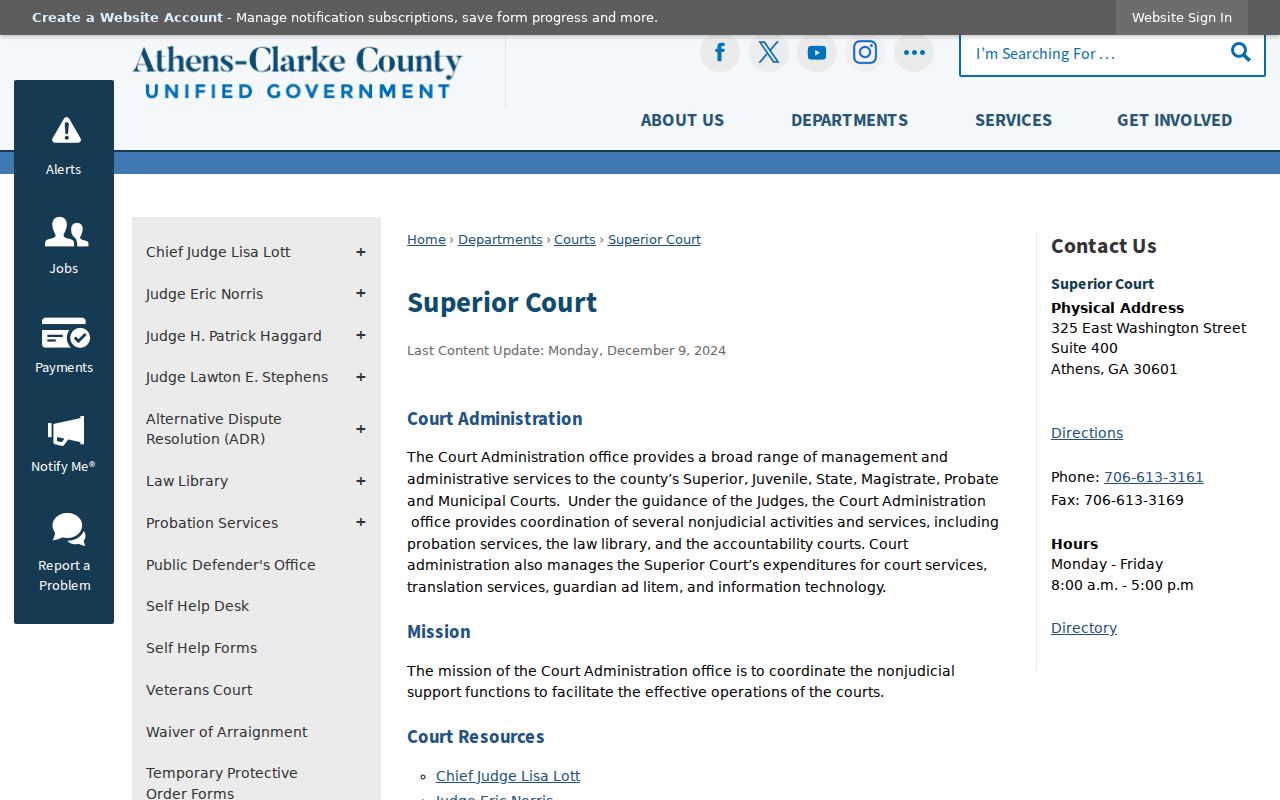
Its separate identity helps explain why a broad county web request does not automatically return the full felony file.
How to Search Case Records
Georgia Judicial Gateway and re:SearchGA provide access for participating courts, but Georgia has no single free public portal guaranteed to contain every Clarke County criminal case. Use a portal result as a lead, then request the clerk-held file when completeness or certification matters.
- Identify Superior, State, Magistrate, Municipal, or Juvenile Court from the charge and paperwork.
- Use the exact case number when known; otherwise give the name used at arrest and an approximate filing year.
- Review the docket for charge, hearing, plea, order, disposition, and sentence entries.
- Ask the clerk about an older or missing file instead of assuming that no online result means no case.
- Order a plain or certified copy that matches the purpose of the request.
| Field Label | Type | Required | Notes |
|---|---|---|---|
| Party name | Text | When number unknown | Use the name shown on the court record. |
| Case number | Text | Best identifier | Formats vary by court. |
| Filing date or year | Date/year | No | Helps the clerk locate older material. |
| Court or division | Selection/request detail | Yes | Clarke files are split among courts. |
| Charge or record detail | Text | No | Useful on a Magistrate mail request. |
Older Clarke Magistrate Criminal Dockets
Clarke County Magistrate criminal records date from December 24, 1960. Cases before November 4, 1992 sit in handwritten docket books; later matters have computerized dockets. For files dated 1992 or earlier, Magistrate Court cannot supply a full file copy, but it can provide a docket-book copy. That is a real limit of the surviving format, not proof that an event never occurred.
A mail request should include dates, case number if known, the name used at arrest, parties, charges, the required fee, and a self-addressed stamped envelope. The published Magistrate request form offers Civil or Criminal selection. It is a court-specific request, not an all-county history search.
What the Case File Shows
A Clarke County case file follows the litigation rather than the arrest alone. The public interface was not reliable enough during research to document exact controls, so the inventory below describes fields a clerk-produced docket or file can contain without claiming that each is visible online.
| Case Number & Court | Clerk identifier, filing date, division, and judge. |
|---|---|
| Charging Document | Accusation, information, or grand-jury indictment and cited charge. |
| Docket Entries | Pleadings, motions, orders, counsel, costs, and linked warrants. |
| Hearing Dates | Arraignment, motion, plea, trial, and sentencing events. |
| Disposition & Judgment | Dismissal, acquittal, plea, verdict, nolle prosequi, or other outcome. |
| Sentence & Conditions | Confinement, probation, restitution, and other entered terms. |
Clarke Court Copies and Certification
The Superior and State clerk posts several product prices. Unassisted copies cost $0.50 per page, while assisted or mailed copies cost $1 per page. A certified copy costs $2.50 for the first page and $0.50 for each later page. Computer printouts are $2.50 per page. Fax or electronic delivery costs $2.50 for the first page and $1 for each later page.
Payment options are cash, money order, certified bank check, Visa, or Mastercard, with a 3 percent card fee. Personal checks are not accepted. Magistrate Court posts a different schedule, including $0.25 per page, $4 certified-copy wording, and $14 for a certified file. Confirm the exact product before paying because the correct schedule depends on the court and record.
The Clarke State Court page identifies the local misdemeanor layer.
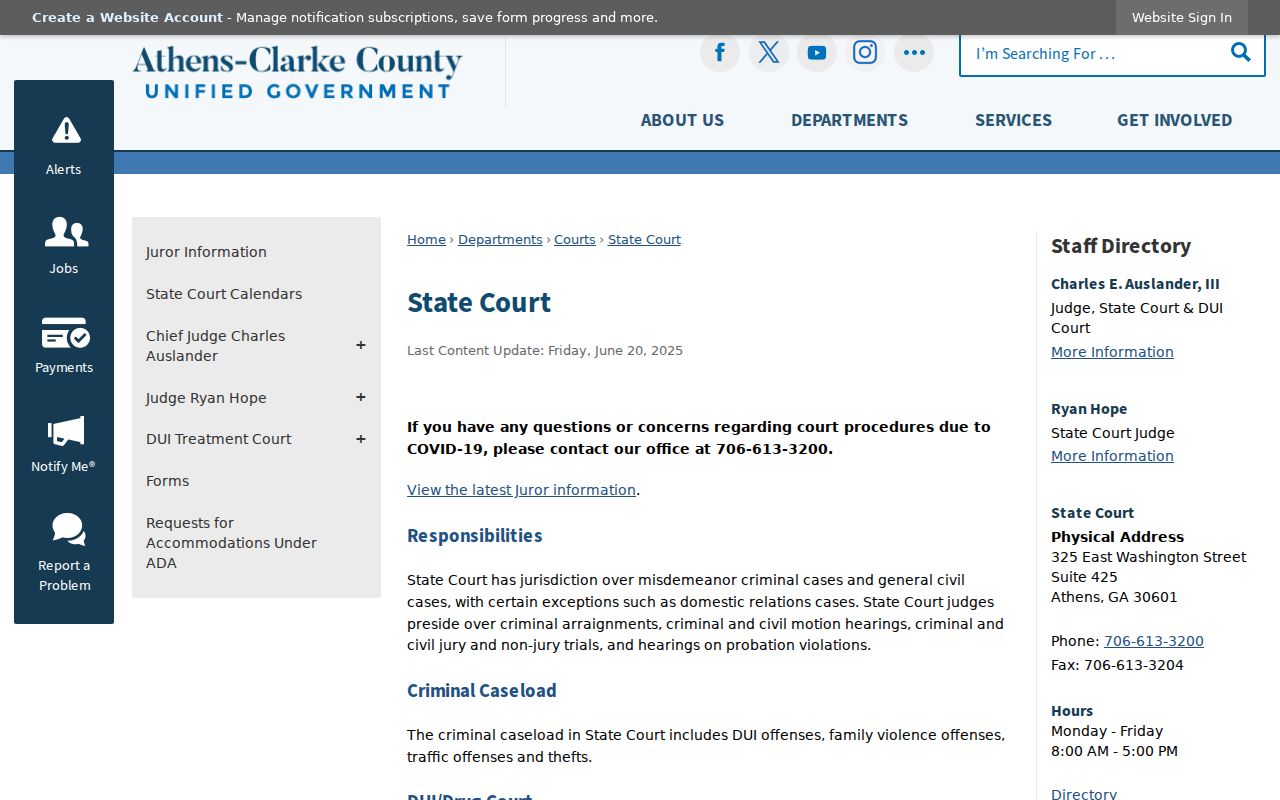
Keeping State Court separate from Superior and Magistrate requests prevents a search from stopping at the wrong counter.
Stages of a Criminal Case
An arrest may lead to a first appearance, but the filed case begins when a prosecutor uses an accusation, information, or grand-jury indictment. The defendant is arraigned, pretrial motions and discovery follow, and the case ends through a plea, trial, dismissal, or another disposition. Sentencing follows a conviction. The jail says a person unable to post bail is brought before a magistrate within 72 hours, which is the supported local timing statement.
Case flow: Charges Filed › Arraignment › Pretrial › Plea or Trial › Disposition › Sentencing
Why Clarke Booking Charges Can Change
The jail records the charge presented at booking. The Western Judicial Circuit District Attorney may later accuse a case, present a felony to the grand jury, decline a charge, or file a different statutory count. That makes the clerk's final docket the better source for the filed charge and outcome. Readers tracing an arrest can use the contextual Clarke County arrest history page for custody fields, then return to the court file for the litigation result.
The District Attorney's official page describes the office that handles cases containing at least one felony and related proceedings.
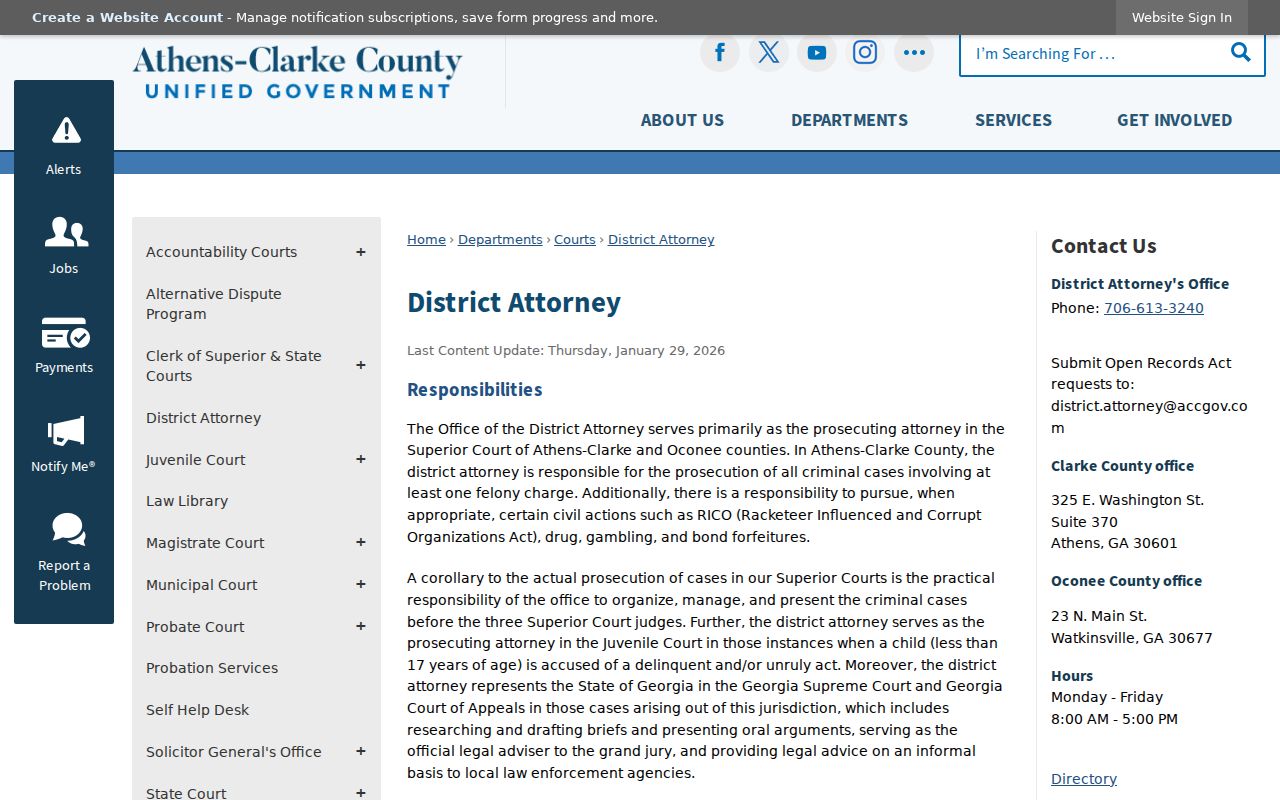
This prosecutorial step is why an arrest label and a filed Clarke County charge should never be treated as identical.
Access & Restrictions
Georgia court records are generally open, but public access is not absolute. Juvenile matters, sealed files, victim or minor identifiers, and sensitive personal information can be restricted or redacted. A missing online document may exist only at the clerk, may not have been digitized, or may be lawfully unavailable. Ask the clerk which explanation applies.
Georgia record restriction under O.C.G.A. § 35-3-37 limits eligible GCIC history, while subsection (m) sealing addresses eligible court materials. One does not automatically substitute for the other. Courts may apply clerk access rules rather than the executive-branch GovQA process. Under the Georgia Open Records Act, agencies need not create a new analysis or criminal-history compilation.
Clarke Defense and Federal Court Layers
The Western Circuit Public Defender accepts walk-in municipal intake on weekdays from 9 a.m. to 3:30 p.m. at 440 College Avenue, Suite 220. Income qualification applies, and a $50 application fee may be assessed. Its records and representation role are distinct from the clerk's public case file.
The county right-to-an-attorney page documents that local intake channel.
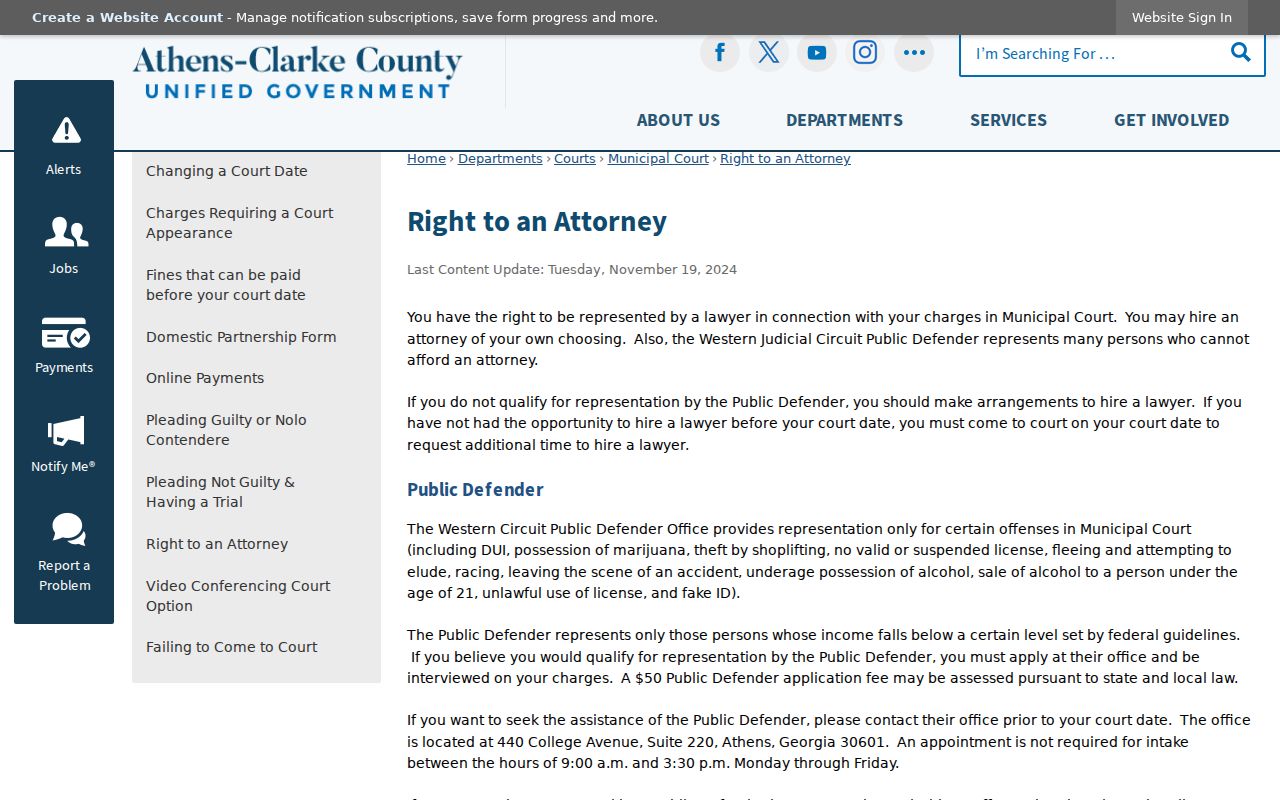
The page gives a direct local route for a person seeking appointed counsel, while the court clerk remains the record custodian.
Federal prosecutions are separate. Clarke County lies in the Middle District of Georgia, Athens Division, and PACER supplies federal dockets. The Middle District's official site identifies the federal court layer at Hancock Avenue.
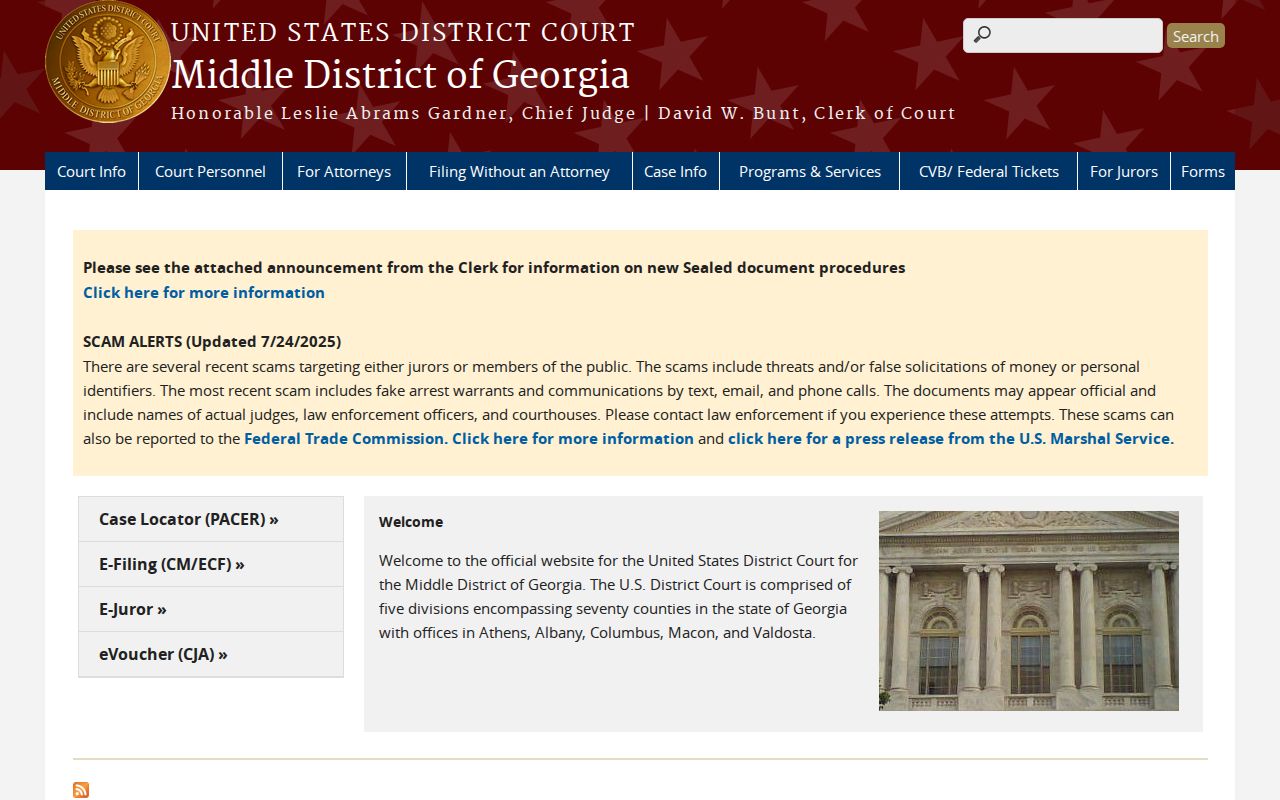
A PACER result does not replace a Clarke County clerk search, and a county search does not reveal a federal docket.
Reading Clarke Criminal Dispositions
A disposition describes what happened to a charge. A nolle prosequi is the prosecutor's formal choice not to pursue it at that time. A dismissal ends the charge through court or prosecutor action without conviction. An acquittal is a not-guilty trial result. A no bill means the grand jury declined to indict. These outcomes differ from a guilty plea or verdict and should be read charge by charge.
First Offender is a Georgia disposition mechanism that can avoid an adjudication of guilt after successful completion when statutory conditions are met. Dead-docket and restriction issues can require more context than a short docket label supplies. Obtain the actual order when the precise legal result matters, and compare it with the reported GCIC cycle if the statewide history lacks the outcome.